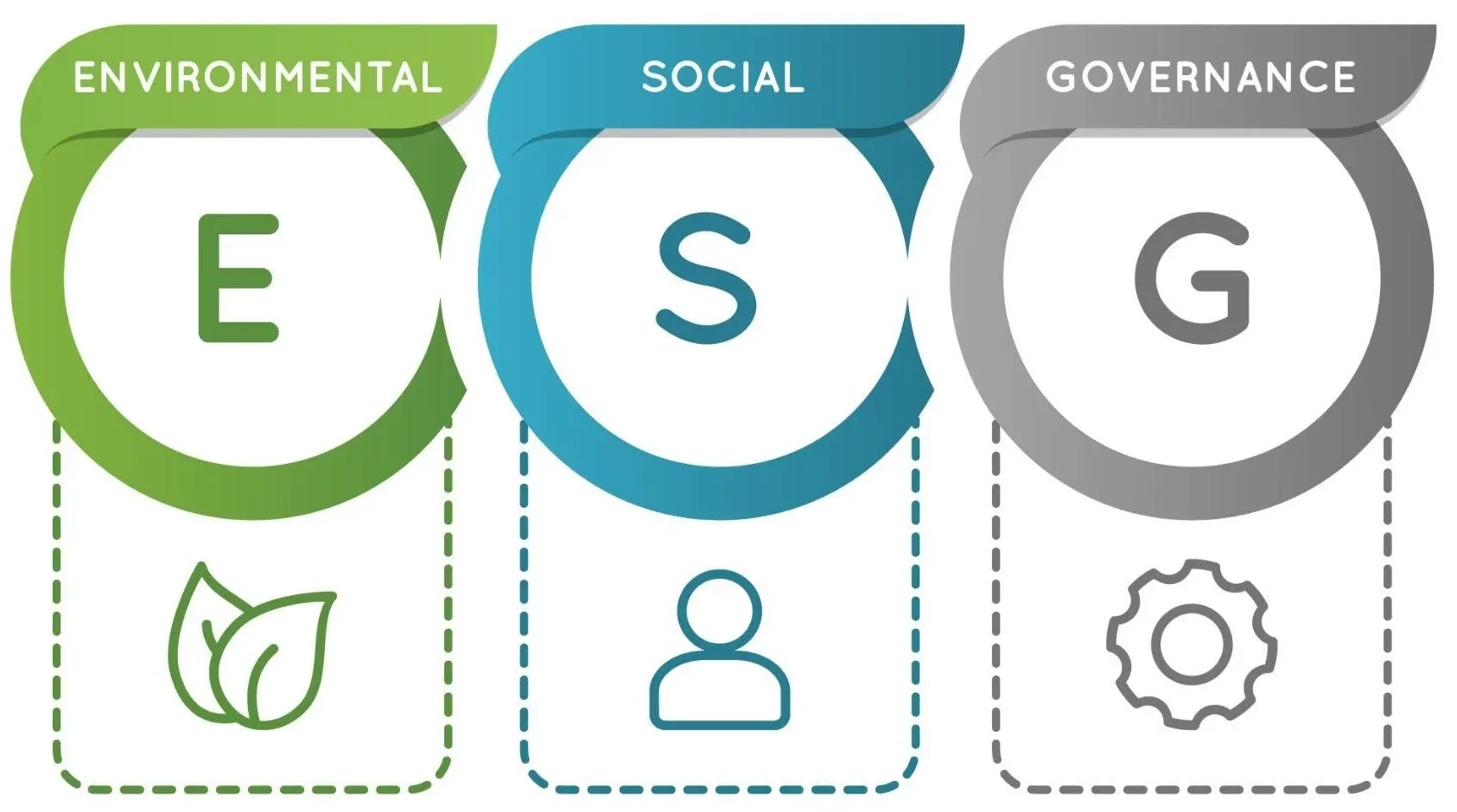
ESG full form stands for Environmental, Social, and Governance. It is a framework for evaluating a company’s sustainable and ethical performance beyond traditional financial metrics. Environmental factors examine issues like climate policies, resource use, waste and emissions; social factors cover workplace practices, community engagement and human rights; and governance factors involve leadership, transparency and shareholder rights. These three pillars overlap (as shown below) to give a holistic view of a company’s impact on the world.
The “ESG” framework integrates Environmental, Social, and Governance factors into one analysis. Each pillar has specific criteria to guide investors and managers.
-
Environmental: Focuses on a company’s impact on nature. For example, it looks at climate policies, energy consumption, waste and pollution management, conservation of natural resources, greenhouse gas emissions, and compliance with environmental laws.
-
Social: Examines how a company manages relationships with people and society. This includes labor practices (fair wages, health and safety), diversity and inclusion, community engagement or philanthropy (such as donating profits or encouraging volunteering), and how it treats customers and suppliers.
-
Governance: Covers corporate leadership and ethics. Key factors include transparent accounting and controls, board structure and diversity, executive compensation, shareholder rights, and avoidance of conflicts of interest (e.g. not using political contributions for undue influence).
Understanding the ESG full form clarifies that these are non-financial but material risks and opportunities. As Investopedia explains, “ESG stands for environmental, social, and governance”, and ESG investing refers to approaches that prioritize how companies perform on these metrics.
Why ESG Matters: Risks, Reputation, and Returns
ESG is no longer a niche topic – it’s central to modern finance. Companies with strong ESG performance tend to be viewed as lower-risk and more forward-looking. For example, an Ernst & Young survey notes that many investors now believe high-ESG companies are “less risky, better positioned for the long term and better prepared for uncertainty”. In other words, good ESG practices can signal better risk management (e.g. reducing environmental or regulatory risks) and resilience.
Key reasons why ESG matters today include: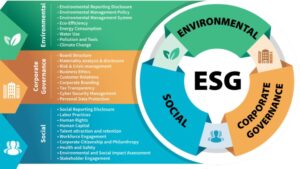
-
Risk management: Companies that manage environmental and social issues effectively often face fewer fines, lawsuits or disasters. Investors value this – EY found that firms performing well on ESG are perceived as safer bets.
-
Capital allocation: Major investors and banks now use ESG data when allocating capital. In fact, “ESG has changed how capital allocation decisions are made” by large financial firms. Many asset managers integrate ESG into their analysis, believing it can signal long-term value.
-
Stakeholder confidence: The ESG framework helps companies address sustainability challenges and stakeholder expectations. According to the Corporate Finance Institute, ESG “helps stakeholders understand how an organization manages risks and opportunities around sustainability issues.”. Transparent ESG practices can build trust with customers, employees, and regulators.
-
Consumer and talent appeal: Surveys show strong public support for ESG. For instance, a PwC study found 83% of consumers expect companies to adopt ESG best practices, and 76% of employees prefer to work for firms that share their social or environmental values. Good ESG credentials can enhance brand reputation and help recruit top talent.
In practice, this means most large companies now report on ESG. For example, the vast majority of S&P 500 firms publish sustainability or ESG information – 99% did so in 2023 (up from 98% in 2022). This reflects investor and regulatory pressure for disclosure. Managing ESG properly can unlock benefits like better investor access, lower cost of capital, and positive public image, while neglecting it can leave businesses vulnerable to emerging risks.
ESG Investing: Aligning Profit with Principles
ESG investing refers to investment strategies that consider a company’s ESG performance alongside financial metrics. It is also called sustainable, responsible, or impact investing. In an ESG portfolio, investors may screen out companies with poor ESG scores (such as those with high pollution or labor controversies) and favor ones with strong ESG records. For example, many ESG funds exclude “sin” industries like tobacco or certain defense contractors. These exclusions can affect returns: tobacco and defense stocks have historically had strong performance, so avoiding them may mean a trade-off that some ESG investors accept for ethical reasons.
The growth of ESG investing has been dramatic. Morningstar reported that by Q4 2024 there were about $3.2 trillion in sustainable funds worldwide. Asset managers and brokerages offer numerous ESG products – from ESG-themed mutual funds and ETFs to green bonds and even ESG-focused index funds. Robo-advisors like Betterment and Wealthfront also promote ESG portfolios to younger investors. In the US alone, the US SIF Foundation documented $6.5 trillion in assets tagged as sustainable (about 12% of all managed assets) at the start of 2024. A growing number of investors now choose ESG-aligned portfolios: Morgan Stanley found that a large majority of individual investors are interested in sustainable investing (88% globally) and plan to increase their allocations.
ESG investing can take many forms. Some portfolios use negative screening (excluding certain industries), others use positive screening (actively choosing companies with high ESG scores), and some focus on thematic goals (e.g. renewable energy or gender diversity). Many investment firms also engage with companies on ESG issues or vote on shareholder resolutions related to ESG. Ratings agencies like MSCI and Morningstar now publish ESG scores and ratings for thousands of companies, helping investors identify opportunities.
ESG Investing Strategies
-
Integration: Embedding ESG factors into traditional financial analysis to improve risk assessment.
-
Screening: Excluding (negative screening) or including (positive screening) companies based on ESG criteria.
-
Thematic and Impact: Targeting specific sustainability goals (e.g. carbon reduction, community development) via dedicated funds.
-
Engagement: Active owners may push companies to improve ESG practices through engagement or proxy voting.
By aligning portfolios with ESG factors, investors hope to achieve competitive returns and positive societal impact. Surveys indicate that most investors no longer see a large trade-off: 85% of a recent sample believed funds can deliver market-like returns while making a positive impact.
ESG Reporting and Standards
With ESG’s rise, the demand for reliable ESG data has grown. Companies increasingly report ESG performance through sustainability reports and regulatory filings. For instance, nearly all S&P 500 firms (99%) reported some sustainability information in 2023, often following globally recognized frameworks like the GRI or SASB standards. New rules are also coming: in 2023 the IFRS Foundation’s International Sustainability Standards Board released its first sustainability disclosure standards (IFRS S1 and S2) to create a global baseline for ESG reporting. By late 2023, over 90 major companies had already mentioned these new IFRS standards in their reports.
Regulators in many regions are also tightening ESG disclosure. In the US, the SEC has finalized new climate-related disclosure rules for public companies, and in Europe the Corporate Sustainability Reporting Directive (CSRD) will soon require large firms to report ESG information in line with the European Sustainability Standards. As a result, transparent ESG reporting is becoming the norm. Many companies now have dedicated sustainability teams, track metrics like carbon emissions or water usage, and obtain third-party assurance on their ESG data (73% of reporting S&P 500 companies got some kind of assurance on their 2023 sustainability data).
Overall, the ESG full form has expanded from a simple acronym into a comprehensive system of measurement. Its principles are increasingly embedded in corporate strategy: for a business, adopting ESG might mean cutting emissions, improving labor practices, and having a diverse, accountable leadership team.
Criticisms and Challenges of ESG
Despite its popularity, ESG faces criticism and challenges. Notably, many warn of greenwashing – companies or funds touting ESG credentials without real substance. Critics say some firms adopt ESG policies as PR moves while continuing harmful practices. This can erode trust: recent surveys find most investors worry that greenwashing is a growing problem.
Other concerns include:
-
Lack of standard metrics: There is no single, universally accepted ESG rating. Different agencies (e.g. MSCI, Bloomberg, ISSB/IFRS) use their own criteria, and results can vary wildly. This inconsistency makes it hard to compare companies and invites skepticism. Even within a company, ESG goals (e.g. a diversity target vs an environmental goal) can compete or conflict.
-
Over-broad scope: ESG covers many issues, from climate to workplace safety. Some argue it’s too ambitious to condense all that into one score. Many companies may prioritize certain aspects more than others, making a single ESG measure reductive.
-
Return trade-offs: Since ESG portfolios often exclude profitable sectors (like oil & gas or tobacco), some investors may sacrifice returns. For example, tobacco and defense stocks historically delivered strong returns, so omitting them can limit gains. According to Investopedia, many ESG investors knowingly accept a potential 10% return loss over five years to align with their values.
-
Political backlash: In some regions, ESG has become politicized. In the U.S. for instance, a number of states have passed anti-ESG laws. West Virginia barred ESG-focused banks from state business, and Florida banned state pension funds from investing in ESG-branded funds. Such measures reflect a view that ESG may harm traditional businesses or prioritize ideology over profit. This politicization can hinder the flow of ESG capital and slow corporate action.
In summary, while ESG aims to improve corporate responsibility and investment outcomes, it is not without controversy. Critics call for more rigor and standardization to ensure ESG efforts have real impact, not just empty labels.
The Future of ESG
All signs point to ESG growing even more central in finance. Institutional trends and investor sentiment suggest sustainable investing will expand. For example, 73% of surveyed asset managers expect the sustainable investing market to grow in the next couple of years. Younger generations are driving this: a recent Morgan Stanley survey found 80% of Gen Z and Millennial investors plan to increase their allocations to sustainable investments, compared with far smaller percentages of older cohorts. Globally, 59% of investors said they intend to put more into sustainable funds over the next year.
As regulations strengthen and more data becomes available, ESG analysis should become more standardized. Initiatives like the ISSB standards and EU directives aim to harmonize reporting, reducing confusion. Technology (like ESG data platforms and AI analysis) will help investors parse non-financial data more efficiently. Meanwhile, climate change and social issues remain urgent global challenges, putting pressure on firms to improve their ESG profiles.
In practical terms, we can expect more ESG products (e.g. climate-focused bonds, social impact funds) and more mandatory disclosure regimes. Investors are increasingly seeing ESG integration as part of fiduciary duty, not just a fad. As one expert noted, aligning portfolios with ESG can have “positive effects on society and the environment” while still seeking competitive returns.
Overall, for anyone interested in finance or financial literacy, understanding the ESG full form and its implications is essential. ESG is reshaping investing by embedding sustainability into the financial system. Whether you’re a professional investor or a personal saver, knowing what ESG is and why it matters will help you make informed decisions in the years ahead.