Paytm, established in 2010 by Vijay Shekhar Sharma, is now India’s leading digital payments firm. Its journey is one of disruption and innovation: a mobile recharge venture which surfed the wave of demonetization in 2016 to become mainstream. Paytm grabbed headlines in 2021 with India’s biggest-ever IPO (raising $2.5 billion at a $19 billion valuation). But its stock fell steeply on listing, demonstrating the volatility of the markets. This Paytm case study analyzes the company’s trajectory — from its establishment and business model to its going public and afterlife — and contrasts Paytm with competitor PhonePe. Investors, newbies, and marketers will discover data-driven insights here about Paytm’s strategy, challenges, and competitive landscape.
Origins & Early Growth (2010–2016):
Paytm founder Vijay Shekhar Sharma at a stock market event. Paytm was launched in 2010 by Vijay Shekhar Sharma as a bill-pay and mobile prepaid platform. During its initial years the startup operated digital wallet services. The turning point was in late 2016, when India demonetized its ₹500 and ₹1,000 banknotes overnight. This shortage of cash pushed millions of consumers online, and Paytm’s user base skyrocketed as individuals looked for alternative non-cash payment options. By 2017, Paytm was already processing hundreds of millions of transactions – Reuters reported it had around 220 million users at that time. The company took the thrust of this momentum to enter UPI payments, merchant point-of-sale devices, and other financial products.
Business Model & Revenue Sources:
Paytm’s business is supported by two pillars: merchant payments and lending. The firm levies fees from businesses on payment processing and value-added services (such as soundboxes and card readers) and makes a commission on loan and financing products. In reality, close to 60% of Paytm’s top line is generated by merchant services, followed by 20% from lending (by partner NBFCs). The other products and services include mobile wallet/top-up, e-commerce (Paytm Mall), ticketing, and so on. Paytm further introduced Paytm Payments Bank to access remittances and deposits, although RBI subsequently directed the arm to close down due to regulatory problems.
Principal revenue streams:
- Merchant payments: Subscription and platform fees from merchants for using Paytm’s payment devices and gateway.
- Loans & finance: Consumer and merchant lending through partners; Paytm receives a share of the interest.
- Other services: E-commerce, ticketing, insurance, and digital wallets contribute minor proportions.
In 2023 ,Paytm had more than 100 million monthly active customers and focused more on profitability. Its third-quarter 2023 income soared 38% to ₹2,850 crore, led mostly by merchant lending and subscriptions (investing.com). The company reduced its net loss substantially, reflecting better cost management. In all, Paytm has followed a plan of using its gigantic user base and merchant ecosystem, then making money through subscription charges, interest from lending, and marketing tie-ups.
IPO and Investor Reception:
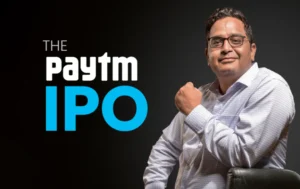 Paytm’s 2021 IPO was a historic moment. In November 2021 One97 Communications (Paytm’s parent) raised approximately ₹18,300 crore, the largest IPO in Indian history. Vijay Shekhar Sharma became a household name, and Paytm temporarily seemed like an icon of national digital finance. But soon markets turned against them. Paytm’s stock price tanked on listing day — closing 27% below issue price on listing day. By late 2023 the stock had declined even more (Paytm’s U.S.-listed shares were much lower than their IPO level, according to TechCrunch).
Deep-pocketed investors noticed: SoftBank had put in $1.4 billion for a 20% stake in 2017 but slowly trimmed its holding (by early 2024, SoftBank’s holding was below 3%). In 2018, Warren Buffett’s Berkshire Hathaway went on to famously acquire a 3% stake ($260M) in Paytm, only to lose 40% by 2023. Early investor Alibaba and others trimmed stakes too. These exits betokened investor anxiety about Paytm’s growth slowdown and regulatory woes. The duplicitous IPO aftermath betrays the speed at which valuations and fortunes can turn in fintech.
Paytm vs. PhonePe: UPI Wars
India’s Unified Payments Interface (UPI) market is dominated by PhonePe and Google Pay, with Paytm in distant third position. As of late 2024, PhonePe has around 47.8% of UPI transaction volume and Google Pay around 37%. PhonePe (owned by Walmart) has 590 million registered users and 48.4% of UPI payments (January 2025). It has more than 310 million transactions per day. PhonePe became profitable in FY2024 (₹1.97 billion pre-ESOP profit versus a loss last year) and is targeting an IPO in 2025.
Paytm’s UPI penetration weakened after RBI clamped down in 2024. Paytm’s monthly transacting users (MTU) declined from 100 million (pre-clampdown level) to 70 million by Sept 2024. Its payments revenue plunged 37% in the quarter. PhonePe and Google showed continuing growth in contrast. The following chart summarizes key data:
PhonePe – 590M users; 48% UPI market share; first profit in FY2024.
Google Pay – 37% UPI market share (Nov 2024); extensive user base through Android integration.
Paytm – 70–100M active UPI users (dropped 25% to 70M in late 2024); focus on merchant revenue (60% of revenue); returned to profitability by mid-2025.
In spite of headwinds, Paytm has strengths: big merchant base and diversified services (e-commerce, insurance, ticketing). PhonePe’s strength lies in its app ecosystem and deeper pockets of Flipkart/Walmart. For consumers, all three provide cashbacks and promotions – a decisive competitive consideration in India’s price-sensitive market. Overall, Paytm vs. PhonePe presents two strategies: Paytm as ecosystem play (wallet-to-bank), PhonePe as UPI-first growth play.
Leadership & Founder Profile
Paytm’s mission has been steered by founder Vijay Shekhar Sharma (b. 1978). A graduate in engineering who sold his first venture for $1M in 1999, Sharma founded One97 Communications and subsequently Paytm. His leadership was recognized with awards: he was India’s youngest listed billionaire and part of Time 100 in 2017. Forbes reported in September 2022 that Sharma’s net worth was $1.1 billion, and by 2024 it was roughly $1.15 billion. (His fortune largely from Paytm equity.)
At Sharma’s helm, Paytm ventured hard into new domains such as banking and fintech. He raised marquee investments (Alibaba, SoftBank, Berkshire) and led Paytm’s becoming a “one-stop” digital financial marketplace. Sharma has also been vocal on Cashless India and frequently interacted with media and policymakers for encouraging digital payments. In 2024, amid regulatory scrutiny on Paytm Payments Bank, Sharma stepped down from that board role, calling the RBI’s orders a “speed bump”. His career illustrates both entrepreneurial success and the challenges of rapidly scaling finance businesses in a regulated industry.
Key Insights & Takeaways:
Strategic timing matters: Paytm rode the 2016 demonetization push to acquire users fast. Timing product launches with market shifts can create leaps in growth.
Diversify revenues: By creating several revenue streams (payments, lending, subscriptions), Paytm diversified risk. Other startups can learn how to balance growth with monetization.
Regulatory risk: Paytm’s RBI issues in 2023–24 highlight that fintech-agnostic founders have to focus on compliance. Investors should factor such risks into fintech bets.
Competition is intense: Despite a head start, Paytm faces competition. Success could depend on partnerships, innovation (e.g. AI/ML for fraud detection), and user incentives.
Investor patience: Early investors experienced mixed results (SoftBank’s massive India wager cut back; Buffett loses on Paytm). This example demonstrates that valuations of startups can reverse sharply.
Inspiration:
- Paytm expanded from ₹2 lakh seed fund (2010) to a ₹19,000+ crore IPO (2021).
- Merchant payments and lending comprise 80% of its business model.
- Founder Vijay Sharma’s net worth is $1.1–1.15B, who is now among India’s richest tech entrepreneurs.
- PhonePe leads UPI with 48% market share vs. Paytm’s single-digit share, reflecting Paytm’s challenge in user growth.
From Struggle to Strategy: Paytm’s Road Ahead
The Paytm case study is a masterclass in fintech evolution: a clever startup can grow quickly by addressing genuine pain points (such as the cash crisis) and making strategic partnerships. But Market leadership isn’t inevitable — regulatory compliance and competition from deep-pocketed competitors are still crucial challenges. Presently, Paytm is moving on to core businesses (merchant lending, payments) and cost control; recent reports indicate it finally turned profit in mid-2025.
For investors and observers, Paytm’s tale underscores due diligence: think about how a fintech navigates regulations and competition, not merely the number of users. For advertisers, Paytm’s path highlights the force of user incentives and brand trust in winning over customers. As digital payments keep growing in India, Paytm’s next steps (maybe a reversal in user acquisition or new offerings) will be a barometer for the industry.
Interested to know more? Explore more about Paytm’s strategies or contrast other fintech operators. Share this Paytm case study with your fintech-interested colleagues, and look out for more analyses of top companies.
Disclaimer: This article is for informational purpose and doesn’t form part of financial advice.